EFA Video on HP
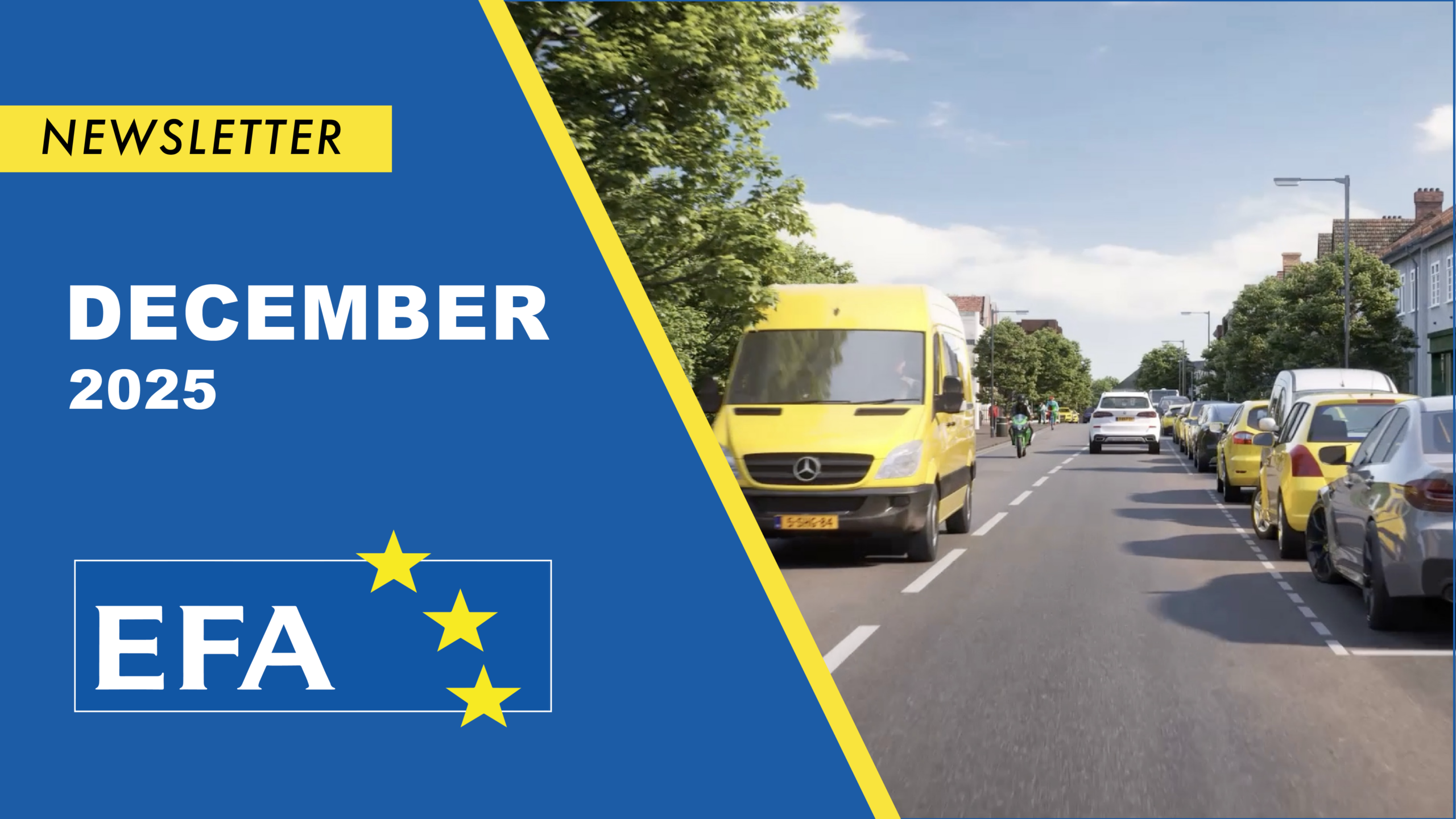
EFA has released its new video on hazard perception for all of us!
The video, reminiscent of the “yellow car game,” aims to raise awareness among road users about hazard perception and paying attention to the road. EFA is having the video translated into many languages, with the goal of being shown and understood at as many driving schools, conferences, and other international events as possible. Special thanks to JellyLearn, whose expertise and technology made the video possible. Enjoy the video here! Help us disseminate it as widely as possible!
EFA participates to the Trendline event on the new road safety KPIs
EFA participated in the Trendline project presentation event, presenting the latest developments regarding the new Driving Licence Directive and the role played by the European Federation of Driving Schools.
The Trendline project brings together 25 EU Member States for data collection, data analysis, delivery of road safety KPIs, and for using them within road safety policies.
The Key Performance Indicators provide information about factors associated with crash and injury risks, e.g., speeding or drink driving.
All the project information can be found at https://trendlineproject.eu/dashboard
The results can be downloaded at https://trendlineproject.eu/trendline-results

Beyond the time-on-task: an EEG-driven approach for effective physiological assessment of mental fatigue in simulated and real driving
Fatigue is a major factor contributing to road accidents, and extensive research has focused on its physiological and behavioral characterization. Due to safety and economic constraints, studies on driving fatigue are commonly conducted in simulated environments, where fatigue is typically induced through prolonged tasks and assessed using a Time-on-Task (ToT) approach. Some EFA collaborators contributed to the publication of this article.
Exploring the impact of autonomous vehicles on youth mobility through focus groups and simulations
The imminent introduction of autonomous vehicles (AVs) represents a significant revolution in transportation, offering unique opportunities to enhance the sustainability and efficiency of urban transport systems. This study uniquely combines qualitative focus groups with European school students and quantitative activity-based simulation models to compare teenagers’ reactions to AVs. Focus groups gathered insights into their current mobility habits and perceptions of AVs. The simulation model then evaluated the potential impacts of AVs, specifically robotaxis and autonomous shuttles, on teenagers’ travel behaviour in Santander, Spain. The results reveal a strong interest in AVs among teenagers, particularly for the independence and flexibility they offer. However, practical considerations such as cost, availability, and parental preferences continue to influence their mobility choices. The simulation results indicate a significant shift towards robotaxis, reducing walking and public transport usage. Gender-specific preferences were also noted, with girls being more likely to use robotaxis. The findings underscore the need for policies that balance AV usage with active modes and public transport, address safety concerns, and ensure equitable access to AVs. The study highlights the benefits and challenges of integrating AVs into teenagers’ lives, offering insights for policymakers and technologists. Further research is needed to validate these findings through real-world trials and to explore the long-term impacts of AVs on teenagers’ mobility, physical activity, and social interactions.
Download the study here
Tapping the potential for reducing work-related road deaths and injuries
Travelling for work is an essential part of Europe’s economy and daily life. Millions of people drive, ride, walk or work on the road as part of their job, whether delivering goods, visiting clients, building and maintaining infrastructure, or commuting to and from their workplace. During these trips, they may be killed or injured, and they may kill or injure another road user. Yet, despite its scale, the risks associated with work-related road use remain insufficiently recognised within both road safety and occupational safety frameworks. Read more about:
https://etsc.eu/tapping-the-potential-for-reducing-work-related-road-deaths-and-inj
International Organisations commit for UN Decade of Sustainable Transport
The International Road Federation (IRF), with a global coalition of partners, announced a voluntary commitment to support the United Nations Decade of Sustainable Transport (2026–2035) to accelerate the transformation towards inclusive, safe, green and efficient road systems for all.
Building on shared expertise and a unified vision for sustainable mobility, the coalition aims to help countries strengthen the way roads are planned, designed and managed to meet the social, environmental and economic challenges of the decade ahead. Read the report
Motorcycle Protection Systems & Safety Aspects Of Management Of Traffic For Motorcycles Report
This document is the outcome of the PIARC Special Project on Motorcycle Protection Systems and Safety Aspects of the Management of Traffic for Motorcycles, conducted under the framework of the PIARC Strategic Plan 2024–2027. The study was initiated by the World Road Association (PIARC) in response to the continuing global challenge of improving the safety of powered two-wheeler users, who remain one of the most vulnerable groups of road users worldwide.
To download the report you have to register in the PIARC website at https://www.piarc.org/en/order-library?publication=47533&solo