
On 18 September, EFA took part in City Flows 2026 in Matera. This international event is promoted by Fondazione Unipolis together with the European Transport Safety Council (ETSC) and the Unipol Regional Councils (CRU Unipol), and it is part of the official European Mobility Week programme. The 2026 edition, held at Casa Cava in the heart of the Sassi, was dedicated to “Disability and the right to autonomous, safe and inclusive mobility.” The organisers’ starting point was that disability is not a niche topic but the lens through which to measure whether a mobility system truly works for everyone.
EFA President Enrique Lorca spoke at the event, presenting Spanish and European experience as good examples that Italy could also follow. Driving schools play a key role in helping people with disabilities gain autonomous and safe mobility, from specialised training to adapted vehicles. This is also why EFA launched a permanent international network of instructors specialising in training drivers with physical impairments, starting with the seminar held in Bielefeld in February 2026.
During the event, Nomisma presented new research for Fondazione Unipolis, including the new Mobility Index, which measures risk, road safety and accessibility across Italian territories. Among the findings: 80% of people with disabilities never use public transport, and 34% of Italian households report difficulties with public transport connections.
EFA and UNASCA congratulate the organisers on the success of the event and thank them for the invitation.

Raffaele Moretti (UNASCA), Enrique Lorca (EFA) e Lucia Vecere (ACI)

EFA took part in the 2026 Annual International Conference (AIC) of the American Association of Motor Vehicle Administrators (AAMVA), held from 29th September to 1st October at the Rhode Island Convention Center in Providence. AAMVA’s flagship event brings together chief administrators of motor vehicle and law enforcement agencies, federal partners and industry stakeholders from across North America and beyond. They meet to share experience and discuss the main issues in driver licensing, vehicle administration and road safety.
EFA was represented by Jiří Novotný and Manuel Picardi, who presented the main European developments in driver training to an international audience.
Jiří Novotný presented the hazard perception application used in recent years in the Czech Republic to train new motorcyclists and car drivers. Novotny showed how the tool helps learners recognise and anticipate risks in traffic. He also explained how EFA’s international certification platform will work.
Manuel Picardi focused on the main changes introduced by the new EU Driving Licence Directive (EU) 2025/2205. He also gave an update on the certification process for driver training, including its link with the EFA training matrix.
EFA’s participation in the AIC strengthens dialogue between European and North American stakeholders on the quality of driver training. It also confirms EFA’s commitment to sharing European good practice beyond the EU’s borders.
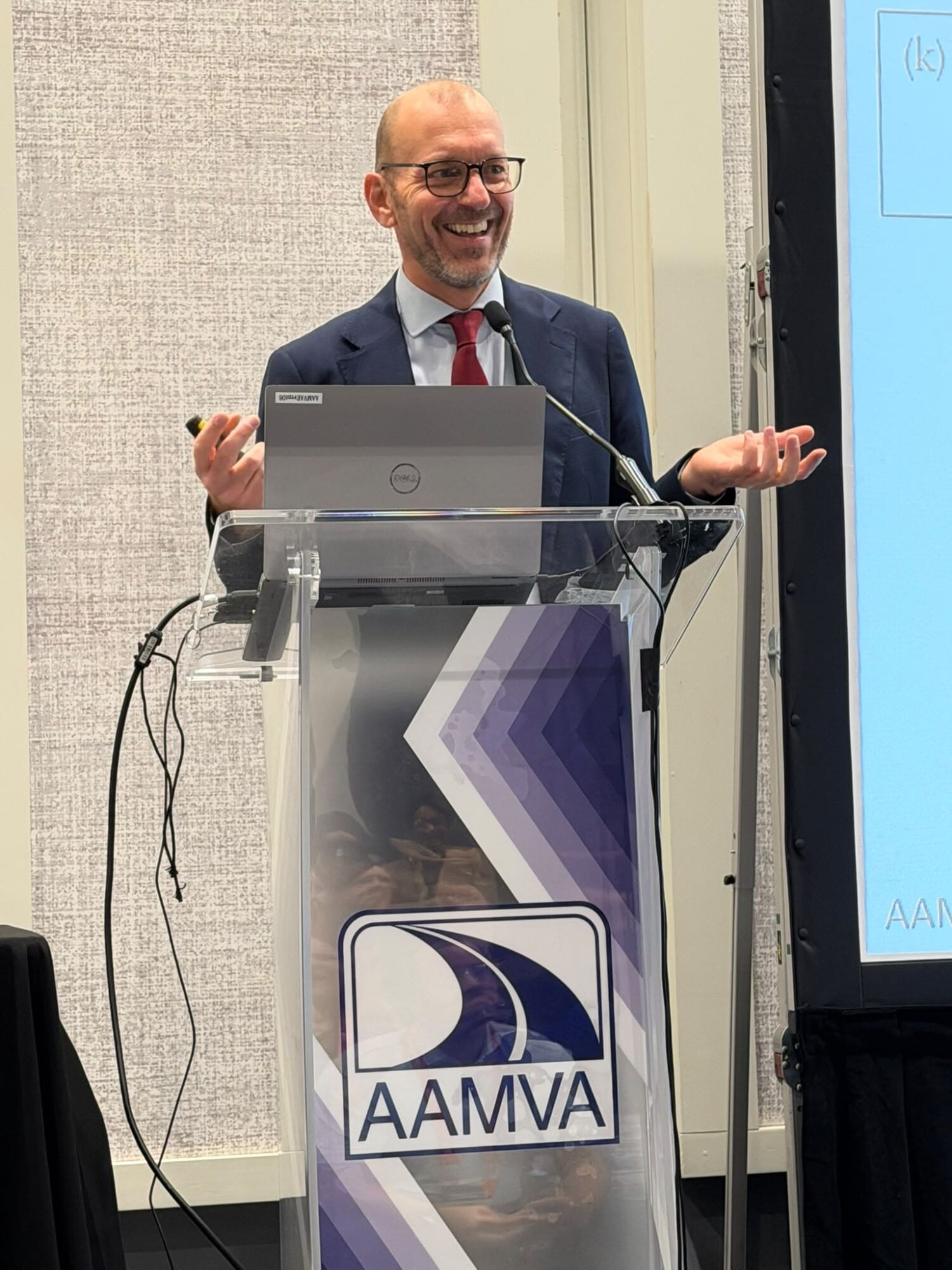
Manuel Picardi
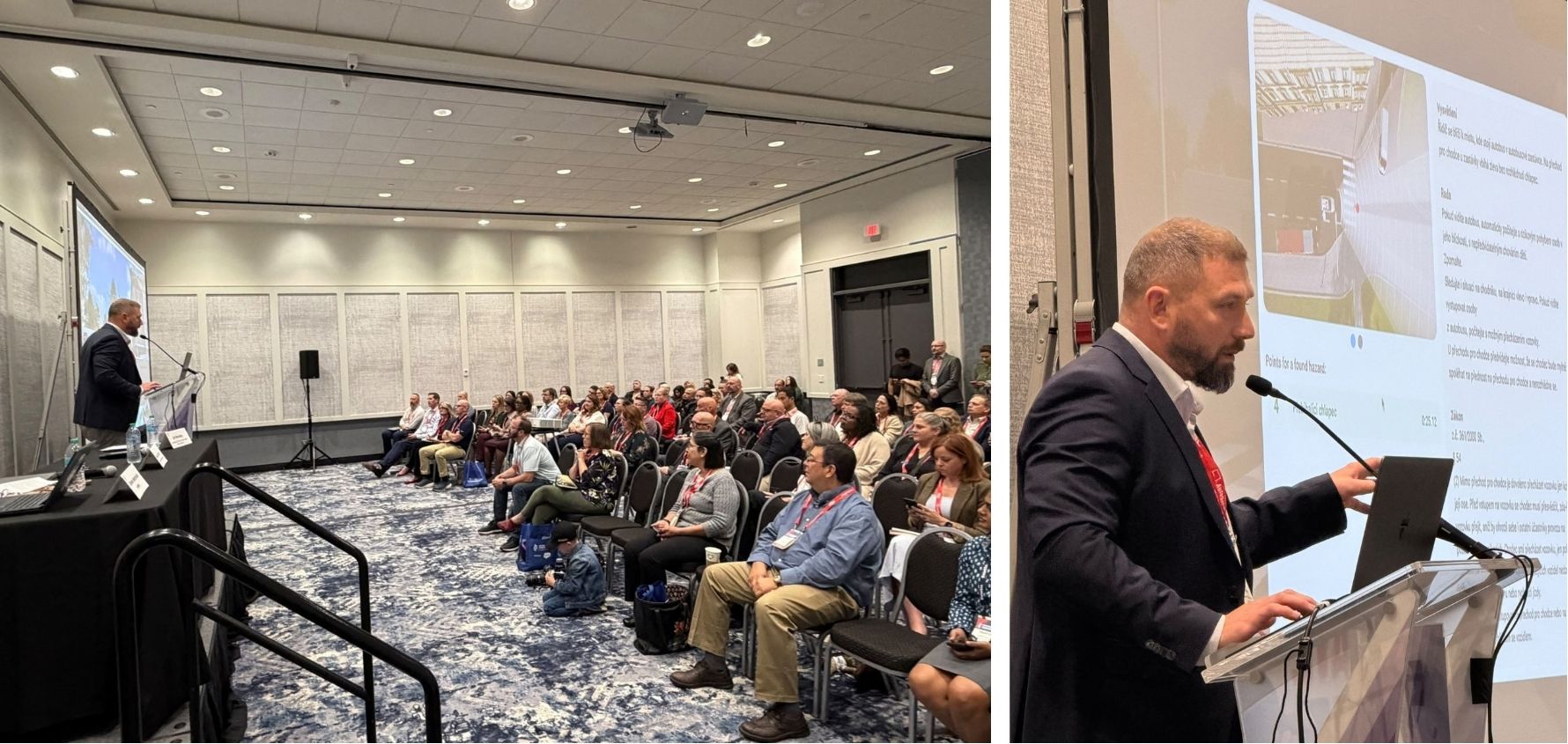
Jiri Novotny
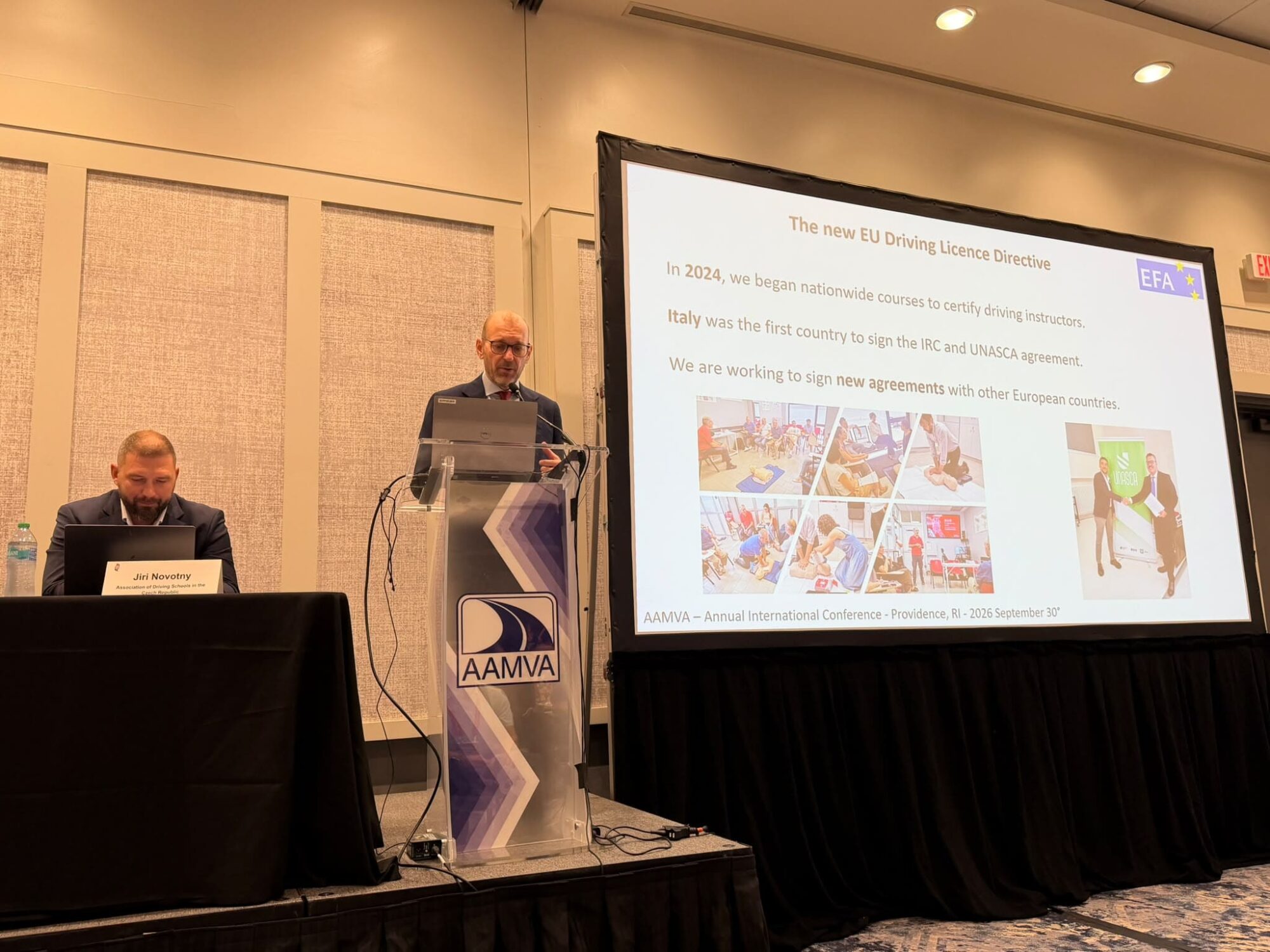
Manuel Picardi and Jiri Novotny

Jiri Novotny with training volunteers
On 11 September 2026, Dr. Manuel Picardi represented EFA at the Wellbeing Working Group organised by ESPORG within the European Wellbeing Initiative (Ewellin). The session was dedicated to wellbeing training for logistics workers. Its aim was to build a common, uniform and holistic wellbeing approach to training logistics workers at every level, both through the mandatory CPC (Certificate of Professional Competence) framework and through complementary pathways.
The meeting brought together representatives of the European Commission, training providers and practitioners. After an overview of the current EU mandatory training frameworks, Dr. Picardi presented the perspective of professional driving schools. Driving schools deliver initial and periodic CPC training to professional drivers every day, which puts them in a strong position to include health and wellbeing topics in their courses. The programme also included the IRU Academy’s approach to training drivers and managers, the training of parking operators through the EU Parking Academy, and a review of best practices already in use.
In an interactive session, participants discussed the form and structure of a possible universal wellbeing module. The discussion aimed at four concrete outputs: priority prevention topics, the structure of the module, how it could be integrated into the CPC and into complementary routes, and shared principles for further collaboration.
The Working Group continues the Ewellin initiative, which in June brought drivers, fleet managers and transport professionals together at Truck Park Brescia Est for three days dedicated to the physical and mental wellbeing of professional drivers. EFA will continue to contribute to the initiative, so that driver wellbeing becomes a structural part of professional driver training.

France’s National Road Safety Council (CNSR) has adopted recommendations that could directly affect driving schools. At its meeting on 17 September, which marked its 25th anniversary, the CNSR proposed three measures: allowing young people to take the theory test from age 14, strengthening training for young road users, and introducing a self-assessment of fitness to drive.
The aim of the first measure is to revive accompanied driving. Driving professionals report a 15–25% drop in enrolments for early accompanied learning, depending on the department. The self-assessment is linked to the new EU framework, since Directive 2025/2205 allows Member States to use a health self-assessment instead of a systematic medical examination for several licence categories. None of these measures is in force yet: the government may adopt them, amend them or set them aside.

Estelle Balit, Yves Goasdoué et Marie-Pierre Vedrenne au CNSR
Spain’s updated traffic regulations take effect on 1 October with a strong focus on vulnerable road users. Royal Decree 518/2026 amends the General Traffic Regulations to better protect pedestrians, cyclists, motorcyclists and users of personal mobility vehicles, and most of its measures apply from 1 October 2026. For driving schools, the most practical change concerns seat belts. Until now, staff in training vehicles were exempt when driving in built-up areas. From 1 October, instructors must wear their seat belt whenever the car is moving, including during practical lessons and tests.

In the United Kingdom, the Driver and Vehicle Standards Agency (DVSA) reports an unprecedented increase in testing capacity. It conducted more than 2.13 million practical driving tests in the 12 months to August 2026, the highest rolling total ever recorded. In August, 52.1% of learners passed, the highest pass rate since April 2021. Waiting times, however, are still above target. In August only 40% of learners waited less than seven weeks between booking and taking their test, which means six in ten waited longer. The DVSA also acknowledged the role of driving instructors in preparing learners properly and in making sure pupils take their test only when they are genuinely ready.

The European Road Safety Observatory has published its 2026 annual report. According to the latest validated data, around 19,400 people died on EU roads in 2025, 3% fewer than in 2024. The decline, however, remains well below the pace needed to reach the 2030 target. The report names excessive speed, drink-driving, distraction and failure to wear seat belts as the main obstacles to further progress. It also points to emerging issues: the growing use of personal mobility devices, an ageing population and the gradual arrival of automated vehicles. Driver training has a direct role to play on all of these topics.
The US Department of Transportation has shut down more than 110 driving schools that had issued commercial driver’s licences to over 5,000 people who failed English-language proficiency tests. The follow-up matters most for our sector: the Department has also launched a nationwide audit of third-party commercial licence testers and of how states oversee them. It is a reminder that quality assurance in training and testing is a concern well beyond Europe.